February, 2022

It is not unusual for appellate authorities to set aside findings of lower Courts and Tribunals, and, in the process, express righteous indignation at the manner in which, and the dilatoriness with which, the facts and issues have been dealt with. Notwithstanding the competence, and the care and caution, with which the original forum might have arrived at its decisions, there is always the possibility that the appreciation of evidence, and the findings arrived at, could be erroneous. It is to address this possibility, that appellate fora exist. Scrutiny of facts and arguments by the appellate fora could lead to validation of the conclusions arrived at, in the matter before it in appeal, or setting right the mistakes and inadequacies that have crept into the original order.

The history of decisions in the area of securities law in India is not wanting in an adequate number of instances in which the appellate authority has either set aside, or remanded for fresh consideration, a matter that has come up before it in appeal. Ordinarily, this should be treated as par for the course, and should not give rise to disproportionate comment or concern. However, when three orders of the Securities Appellate Tribunal (SAT), in a short period of time, not only reject the findings of SEBI, but also contain strong indictments of the officials that passed those orders, it is time to sit up and take notice. There are perhaps inherent systemic flaws that might need to be addressed if the recent strong observations of the appellate body are not to manifest themselves time and again.

First, the specifics. In an order passed on 20-12-2021, SAT held, applying the principle of res judicata, that an order passed by a Whole Time Member (WTM) of SEBI was “wholly without jurisdiction”. The Tribunal went on to add that “the contention of the respondent that the said direction was issued only in pursuance of direction issued by this Tribunal is patently erroneous.” Not satisfied with these observations, the Tribunal went on to state “In a country governed by the rule of law, the finality of a judgement is absolutely imperative and great sanctity is attached to the finality of the judgement… Issuance of a fresh show cause notice leading to the passing of the impugned order is not only abuse of process of the court (emphasis supplied) but has far reaching adverse effect in the administration of justice as held by the Supreme Court in….” Allowing the appeal, the Tribunal ordered the payment of costs by SEBI to each of the appellants in this matter.

In a matter decided on 23-12-2021, while dealing with a case in which there was an inordinate delay in the issuance of the show cause notice, the Appellate Tribunal did not view with favour the act of the Adjudicating Officer in “skirting the issue and pushing it under the carpet without dealing with it”. The Tribunal noted that some of the grounds raised in appeal had not been dealt with by the Adjudicating Officer, and characterised it as amounting to judicial indiscipline (emphasis supplied). In this case too, while deciding the impugned order, the Tribunal allowed the appeal with costs.

In yet another order, the Tribunal stated that the Adjudicating Officer had dealt with an issue in a very casual manner and that “prima facie in our view this amounts to judicial dishonesty” (emphasis supplied).

The findings that the orders passed suffer from judicial indiscipline, and dishonest conduct, do not show in good light the authority which passed the original orders. While it is possible to take sides on whether or not the appellate authority should have come down so heavily on SEBI, the fact cannot be gainsaid that there is perhaps merit in looking at what SEBI needs to do to prevent a recurrence of such observations. In matters involving alleged irregularities and/or misdemeanours, SEBI passes orders, normally through a WTM, who hears the case, and arrives at a decision. In other cases, matters are disposed of by Adjudicating Officers, who are appointed under Section 15 of the SEBI Act, and whose orders can then be appealed against before SAT.

As far as WTMs are concerned, a formal qualification in law, or experience in determining quasi-judicial matters, is not an essential qualification for appointment. The history of SEBI has shown that there have been WTMs whose rich experience prior to their appointment had nothing to do with quasi-judicial matters or even matters of administrative law. Suffice it to say that while they could have arrived at their conclusions based on robust common sense, and on hearing the party proceeded against, the articulation of this conclusions often left a lot to be desired, in the process leaving the doors of appellate opportunity wide open. Unless this is addressed, and persons with some understanding or experience of law are brought in as WTMs, well intentioned efforts could get grounded on technicalities or inadequate appreciation of what is material in the case to be decided.

Some years ago, discouraged by the number of SEBI’s orders that did not survive appellate scrutiny, the senior most functionary in the Ministry of Finance advised the then Chairman SEBI that it might be worthwhile to get the orders proposed to be passed by WTMs either vetted or redrafted by a retired Supreme Court judge. While this suggestion would have improved the quality of the final orders, it was decided to pass up the advice on the ground that outsourcing the writing of orders would be detrimental to the integrity of the process.

SEBI’s bigger problem would seem to lie in the area of adjudication. For many years, SEBI had quite a few Adjudicating Officers who were appointed as such because their services could not be gainfully utilised by the organisation in any of its several departments. It would have been futile to expect Adjudicating Officers, who were thus “parked”, to produce orders that would be able to hold their own in appellate fora. There have been instances where senior officials in SEBI were dismayed after reading some of these orders, and overcome with the helplessness that they could not intervene and correct matters, because the errors could be undone only by the Appellate Tribunal. The resultant transferred reputational risk to SEBI as an organisation because of ill-equipped Adjudicating Officers was a matter that SEBI learned to live with over the years.

There have been a few cases where persons with a legal background and appropriate legal experience have been posted as Adjudicating Officers. The difference in the quality of the orders passed by them, and by the legally untrained Adjudicating Officers, is perhaps a worthy subject for study. Halfway measures, such as putting the legally untrained persons through training programmes, do not travel far enough in producing officers who are equal to the task. Training, experience, attitude and formal qualifications should constitute the package on the basis of which Adjudicating Officers are chosen to discharge such onerous responsibilities.

There are jurisdictions, such as the USA, which select suitable persons for appointment as adjudicating authorities. They come to the assignment with knowledge and experience, and hence are able to arrive at reasoned conclusions that ordinarily survive appellate scrutiny. Sooner, rather than later, SEBI should travel down this path, and have a separately carved out adjudication branch, with persons selected from within or without, on the basis of their ability to deliver quality findings. Differently put, the positions of Adjudicating Officers should no longer be available as parking slots for inconvenient officers.

Capacity building should always be work-in-progress for organisations tasked with catering to public interest through determination of disputed issues. In addition to improving quality, it would reinforce the presumption, presently highly rebuttable, that adjudication is a separate branch, uninfluenced by departmental compulsions and directives.

Yet another initiative could be an audit of all the orders passed in the last few years by Adjudicating Officers. Common deficiencies and systemic shortcomings would then come to surface, rendering it easier for the organisation to put in place the necessary remedial measures. The building of public confidence in the instrumentality of adjudication is far too important a matter to be ignored any longer.

The recent past has shown us that even a Decision Review System (DRS) can be found fault with, and allegations made on the ground that it has been manipulated to serve the interest of one of the contending parties. It is therefore incumbent on all stakeholders of the system to ensure that the quality of first level orders is significantly improved, and references to the DRS become increasingly rare. Speed, clarity, continuity and consistency should be the building blocks of a system that seeks to deliver justice.

Postscript
Even as this piece was taking final shape, there was a news report that the Ministry of Finance was considering a statutory time limit for SEBI notices. Wouldn’t self-imposed discipline be a preferable alternative?

THE STORY SO FAR…
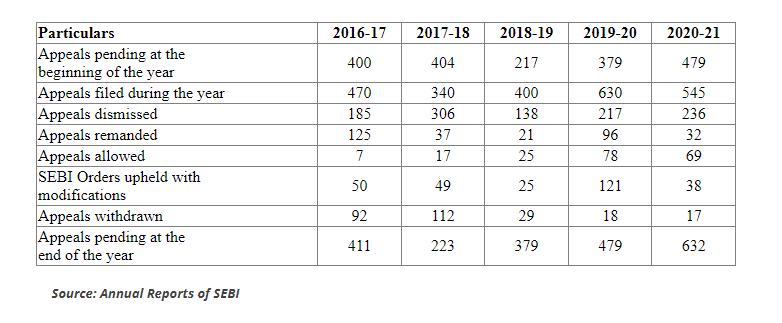
STATUS OF APPEALS BEFORE SAT
Do let us know of any specific issues you would like to see addressed in subsequent issues.
January 2022

At the outset, we at Excellence Enablers wish you and your loved ones a very happy, healthy, peaceful and enriching New Year.

Looking back, 2021 could have been a lot different, and in fact, a lot better. In the first half of the year, as an impatient populace literally dropped guard (read mask), and sought to embrace the active social life that it had missed, Covid-19 struck with a vengeance. Difficult situations give rise to heightened tensions. We witnessed Central and State Governments adopting adversary, confrontationist positions. It was almost as if federalism was on oxygen.

As the year proceeded, there was renewal of hope and faith, with the virus having hit the pause button. Regrettably, with many people believing that it had hit the stop button, and not the pause button, the unwelcome visitor is announcing its presence in a new form.

Given this background, it would have been reasonable to expect that corporate India would treat 2021, as it treated 2020, as a non-year, when it came to economic activity. However, in several sectors, the improved performance was a pleasant surprise. Fingers continue to be crossed on extended good performances, even as the enemy is sought to be kept at bay.

Meanwhile, corporate India witnessed several stand-offs which, on reflection, might have been unnecessary. The Group that first gave India Aap ki Adalat, found itself in the accused box on account of regulation-based allegations. Institutional investors, with assertiveness, seemingly bordering on aggression and adventurism, sought to overthrow Boards and Chief Executives. The movie continues, with no clarity on who will be in the final frame before the “credits” are seen on the screen. Caught in this quagmire, with a shareholding far in excess of what banks normally have in listed entities, one commercial bank is seeking to strengthen its control, while questions are being raised on whether the bank should opt out at a reasonable price. The latest twist in the saga is that an institutional investor group has claimed the shares held by the bank. 2022 will hopefully provide the denouement.

Chief Executives suddenly discovered that good performance is no guarantee of continued occupancy of the corner office. One promoter scion, notwithstanding his good performance, faced shareholder disapprobation for seeking a disproportionate increase in his emoluments. Yet another founder Managing Director discovered that the investors you invite might actually show you the door. Even Steve Jobs had earlier realised that there is no permanent seat in one’s own company.

Yet another high-profile stand-off in the corporate world has seen more twists and turns than the winding roads leading to hill stations. It started out with an overseas Group seeking to acquire strategic material and special rights over an Indian company. A very large Indian entity had already put its foot in the door. When reports last came in, following several rulings in different Courts, a statutory authority had withdrawn the approval given to the foreign entity. It would appear that the battlelines would have to be redrawn, and the issues reframed, because this is not a conflict that will die anytime soon.

It often does not need a foreign entity to stir the pot. In an old family Group, a deed of family settlement has now been called into question, and two sets of cousins are in Court, seeking to assert their respective rights. With the benefit of hindsight, would it be possible to conclude that the present dispute could have been addressed if adequate thought had been invested in the deed of family settlement, and all possible complications arising therefrom had been anticipated and addressed? The battlefronts seem too many, with rights to ancestral homes as well as trademarks and copyrights being contested.

Decades ago, a learned judge of the Supreme Court had posed a rhetorical question as to whether the laws of the Republic extended only up to the gates of the prison. It now seems that some persons in custody, ran not only their business, but also some illegal activities from out of the prison premises. The alleged active connivance of a large number of jail officials, raises the question whether the custody was protective, rather than preventive or reformative. Could these educated persons, who had been jailed, not anticipate that, sooner, rather than later, the long arm of the law will reach them, even within the prison? Even as this dispute has fallen off the front pages of newspapers, there is an alleged conman who reportedly has been using the jail premises, and the services of its employees, to feather his nest. The truth of the statement that “stone walls do not a prison make” is being proved time and again, in a completely different context.

Can anything be more colourful than a whistleblower complaint, which paints the Promoters, in a paints company, in bad light? The alleged dealings of the Promoters in this case, fly in the face of the attempts made by Regulators to prevent unjustified Related Party Transactions (RPTs). A Proxy Advisory Firm, that claims to have done a deep dive, has asserted that this was a conflict of the worst kind, and that the company needed to be saved from the Promoter Directors. The company’s clarifications do not appear to have put the issue beyond scrutiny.

2021 has been the year of mega IPOs. Both institutional and retail investors have responded enthusiastically to IPOs, big and small. In the midst of this excitement, the biggest IPO of the year had a less than lukewarm response. The company concerned had witnessed several high-profile exits in the run up to the IPO. Interestingly, even institutional investors did not see these exits as possible red flags that should have induced them to take a closer look at the hype surrounding the IPO. It is not a matter of minor detail that some institutional investors, who saw the shares list at a depressingly low level, promptly bought more shares at the reduced price. Even as the table thumping, prior to the IPO, followed by the breast beating, after the IPO, occupied media space, the research report, which said that the parent company’s business model lacked focus and direction, seemed to have been lost sight of. Would a lot less hype, and a lot more verifiable fact, have led to a successful IPO, reinforcing the faith of the investors in the retail market?

Arm-twisting and the holding out of threats do not appear to have been absent in the year gone by. In the case of a Japanese company, a threat was made in December, 2020 that if a large University Endowment Fund, acting as a shareholder, voted against the firm’s management, its vote could be subject to a regulatory probe. For reasons that are unclear, the Fund abstained from voting, giving rise to the question whether large funds can be neutralised by empty threats. It was later learnt that there was no basis for any probe to be undertaken. In the midst of this turmoil, the Chairman of the Board pledged to be “an agent of positive change, not a protector of the status quo”. This textbook stand did not find favour with the shareholders, who voted him, and several of his colleagues, out of the Board. It is useful to ponder over the question whether large players should be frightened by empty threats, and whether shareholders should throw out an entire Board without a proposed backup in place.

Conventional wisdom seems to point to the fact that if one crime is committed, and there is a possibility of getting caught out, it would make sense to commit a number of different crimes. A report on the Indian entity of a global chain, brought out allegations by past and present employees, related to promotion of alcohol in prohibited areas, kickbacks, and bribery, in addition to the use of child labour, which surfaced in a subsequent report. The investigation by the outside agency concluded that there were internal control weaknesses, potential improper payments made to Government officials and others, and the possibility of misappropriation of company’s funds, over several years, by some customers. The company’s contention that “we cannot rule out breaches of our policies and code of conduct” and that “several actions have been taken as a consequence of the findings”, falls hopelessly short of giving any confidence to the stakeholder community. In retrospect, the Group might well ask itself whether the desire to expand business prospects should have resulted in almost every conceivable crime or misdemeanour having been committed.

The pandemic-related issues notwithstanding, regulatory hyperactivity continued unabated during the year. There have been far too many directions, guidelines and regulations, which came into being in the last 12 months, and which cannot be gone into here for want of space.

SEBI’s favourite punching bag, the institution of Independent Directors (IDs), which it first created, figured in a number of the existing and proposed changes. One of the major stipulations is that from 1st January, 2022, IDs will need to be appointed with 75% of the shareholding supporting their appointment. This raises the question, why a special resolution would be needed in every case, and why ordinary resolutions will not suffice for first time appointments. Whether the prospect of some of these resolutions being defeated, will stand in the way of good candidates agreeing to be considered for appointment, is something that time will tell. Suffice it to say that this telescoping of two separate proposals in the consultation paper is a remedy worse than the disease. RPTs have also come in for tighter regulations, which in turn have attracted criticism as being disproportionately cumbersome and onerous. Prohibition of Insider Trading (PIT) Regulations have also figured in the list of issues meriting closer scrutiny. The direction that there should be alignment of interests of key employees of the AMC with the unit holders of the Mutual Fund schemes, has not been seen kindly by the workforce of the AMCs. It is believed that while alignment of interests is a laudable objective, the prescription that AMC employees should invest a part of their surpluses in these schemes, seems unduly restrictive. SEBI’s investor grievance redressal system and arbitration mechanism, which seemed to be heavily weighed against investors, has also undergone some changes. Alongside this, SEBI has come out with an investor charter, which will list the non-enforceable rights of the investors interacting with intermediaries in the securities market.

Not to be left behind, RBI has notified an integrated Ombudsman scheme to address some identified pitfalls, arising out of multiplicity of schemes. Its proposal that NBFCs should rotate auditors once in three years, and should have joint auditors, has not gone down too well with the auditor community and the auditee universe.

MCA, on its part, has sought to reinforce the legitimacy of the databank of IDs, maintained by the Indian Institute of Corporate Affairs (IICA). The criticism that the present examination system, leading to inclusion, on application, of one’s name in the databank, is not a worthwhile method of equipping Directors to function better in boardrooms, seems to have been ignored. Several directions have been issued from time to time, extending the last dates for various corporate events. One wonders whether with Omicron rearing its ugly head, 2022 will also see a spate of extensions. Shifting back to original timelines, sooner, rather than later, is a matter that cannot be overemphasised.

Learning from the various mishaps in the banking sector, the RBI focussed on risk management in scheduled banks, as well as in primary (urban) cooperative banks. The Regulatory Review Authority (RRA) was given a fresh life, and it is hoped that by the time this Authority signs off on its efforts, the regulatory landscape would be more relevant and meaningful. RBI and the Government have off and on spoken about the importance of Corporate Governance in the banking sector. Yet, Boards have an extraordinary number of vacant positions in all categories, leading one to wonder whether the responsibility for Corporate Governance will be borne only by the managements that are in position. Auditors have not escaped the attention of SEBI, RBI and NFRA. The ICAI will have to work overtime to reclaim its legitimate place in the regulatory firmament.

The focus on sustainability seems to be gaining pace with SEBI mandating the Business Responsibility and Sustainability Reporting (BRSR) by listed entities during the course of the coming year. Whether this will translate to a universe that both respects and practises the desirable steps for each of the 3 elements, Environment, Social and Governance, remains to be seen.

2021 saw increasing instances of SAT and SEBI arriving at different conclusions based on the same set of facts. However, more excitement was in store when NFRA, the latest kid on the block, decided to cock a snook at ICAI and MCA. If regulatory energy is disproportionately invested in turf battles, and assertion of superior rights, the ill-intentioned elements in the regulated universe will do what they have always done, while applauding the ongoing inter-Regulator skirmishes.

As we enter the new year, it is necessary to remind ourselves yet again, that framing new laws, and writing new regulations, does not automatically translate to better governance and performance. The focus should be on better regulation, than on more regulations. Absent this approach, one will reinforce the old saying “when all is said done, more will be said than done”.

Do let us know of any specific issues you would like to see addressed in subsequent issues.

© 2026 Excellence Enablers. All Rights Reserved.

Subscribe Now