February 2025

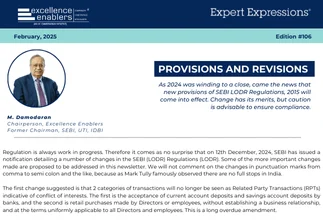
Regulation is always work in progress. Therefore it comes as no surprise that on 12th December, 2024, SEBI has issued a notification detailing a number of changes in the SEBI (LODR) Regulations (LODR). Some of the more important changes made are proposed to be addressed in this newsletter. We will not comment on the changes in punctuation marks from comma to semi colon and the like, because as Mark Tully famously observed there are no full stops in India.

The first change suggested is that 2 categories of transactions will no longer be seen as Related Party Transactions (RPTs) indicative of conflict of interests. The first is the acceptance of current account deposits and savings account deposits by banks, and the second is retail purchases made by Directors or employees, without establishing a business relationship, and at the terms uniformly applicable to all Directors and employees. This is a long overdue amendment. There is no conflict that manifests itself in transactions of this nature, and to treat them as requiring a special dispensation would be contrary to common sense.

The second is a proviso which states that Key Managerial Personnel (KMPs), Directors, Promoters, Promoter group, or any other person, dealing with a listed entity shall disclose to the listed entity all information that is relevant and necessary for the listed entity to ensure compliance with applicable laws. In a regime premised on transparency and disclosures, there should never have been any choice for any of the persons referred to in this clause, to hold back information that is relevant and necessary to ensure compliance.

One major change that has been introduced is that the Compliance Officer shall be an officer who is in wholetime employment of the listed entity, and is not more than one level below the Board of Directors. He/She shall be designated as a KMP. There is no problem whatsoever with designating the Compliance Officer as a KMP. However, given that the CEO is also one level below the Board, having a Compliance Officer at the same level would dilute the overall control and position that goes with the designation of CEO. In many companies, the Company Secretary, who is two or three levels below the Board, functions as the Compliance Officer since there is some commonality between the duties discharged by holders of both these offices. It should have been possible for SEBI to notify that the Compliance Officer, notwithstanding at what level he/she is in the company, should report on compliance matters to the Board or the appropriate committee of the Board. This in no way would have prejudiced the integrity of compliance reporting. By having as Compliance Officer a person one level below the Board, there could be coordination issues between the Compliance Officer and the Company Secretary.

Regulation 17 of LODR, dealing with the appointment or reappointment of Non-Executive Directors (NEDs), on attaining the age of 75 years, also merits some comment. It has been made clear in the relevant proviso that the sub-regulation ought to be complied with at the time of appointment or reappointment or any time prior to the NED attaining the age of 75 years. This again follows logically from the stipulation that no person above the age of 75 shall be a member of the Board, unless his/her candidature has been approved by a 3/4th majority of shareholders. Therefore a Director above the age of 75 continuing on the Board, without appropriate shareholder approval, is an irregularity which should have been specifically addressed earlier.

The Regulation goes on to provide that the approval of shareholders for appointment or reappointment of a person on the Board of Directors or as a Manager is taken at the next general meeting or within a time period of 3 months from the date of appointment. The proviso goes on to state that if the appointment or reappointment of a person to the Board of Directors or as a Manager is subject to the approval of regulatory, government or statutory authorities, the time taken to receive such approvals shall be excluded for the purpose of this clause. This is a welcome move since the extraordinary period of time taken by some regulatory/ statutory authorities to accord clearance often defeated the purpose of appointing a Director without undue delay.

It is by now fairly clear that no amendment of LODR can take place without tinkering with the process of approval of RPTs. The present amendment provides for the Independent Directors (IDs) ratifying RPTs within 3 months from the date of the transaction or in the immediate next meeting of the Audit Committee (AC), whichever is earlier, subject to a few conditions. The first condition is that the ratified transactions, whether entered into individually, or taken together during a FY, shall not exceed Rs 1 crore. This monetary limit seems unduly low and conservative, given that this provision is sought to be introduced to further the cause of improving the ease of doing business. If there is a failure to seek ratification of the AC within the prescribed period, the transaction shall be rendered voidable at the option of the AC. Considering that the transaction is with an external party, voiding the transaction is not going to be free from complications. Further, the amendment states that if the transaction is “with a related party to any Director, or is authorised by any other Director, the Director(s) concerned shall indemnify the listed entity against any loss incurred by it.” Presumably, the reference is to a transaction with “a party related to any Director”, and not with “a related party to any Director”. Further, the causal relationship between the decision and the loss incurred by the entity would have to be established before a Director is called upon to make good the loss.

The present amendment devotes considerable attention to Secretarial Audit and to Secretarial Auditors. It provides in considerable detail the circumstances in which a company can appoint a Secretarial Auditor or a Secretarial Audit firm. The attention given to Secretarial Audit is timely since experience has shown that Secretarial Audit reports rarely point to any mistake or transgression, except when there is a penalty imposed on the company by the Stock Exchanges. Normally, such concerns as are noted by the Secretarial Auditor rarely find a mention in the report. It is perhaps uncharitably explained that with managements satisfaction necessary for the continuation of a Secretarial Auditor, peaceful coexistence is a preferable practice. There is also a provision that a person shall be eligible for appointment as a Secretarial Auditor only if such person is a peer reviewed Company Secretary. This will be an entry barrier for persons who have newly entered the profession, and are yet to get their peer reviewed certificate.

The oft repeated complaint that reclassification of Promoters is taking considerable time, and is very complex has been addressed by these Regulations. What is now required is a no objection from the Stock Exchanges of such reclassification, once it has considered the views of the Board of Directors. Thereafter, the reclassification request shall be placed before the shareholders in a general meeting for approval. Time limits have been prescribed for both the Stock Exchanges’ no objection certificate, and for the approval by the shareholders. This will make life simpler for erstwhile Promoters who over time, on account of reduction of shares held, have lost control over the company, and are in no position to influence any decisions.

Schedule II Part E of LODR has also been amended to provide that listed entities ranked from 1001 to 2000 “shall endeavour” to have at least one woman ID on its Board of Directors. Similarly, it has been provided that the IDs of the top 2000 listed entities “shall endeavour” to hold at least 2 meetings in a FY without the presence of non-IDs and members of the management, and all IDs “shall endeavour” to be present at such meetings. “Shall endeavour” is neither here nor there. There is no clear reason why both the above provisions should not be made mandatory, and why they should figure in the list of non-mandatory provisions. Pleading with the IDs to endeavour to do what is in the interest of the company is not desirable. Such kid glove treatment will ensure that the smaller companies embrace well intended regulations at a leisurely pace. As for the meetings of IDs, Schedule IV of the Companies Act, 2013 presently contemplates at least 1 such meeting during a year. This has been found to be inadequate. Therefore, it would have been better to mandatorily move from 1 to at least 2 meetings of IDs in a year. The considered view of Excellence Enablers is that there should be one such meeting before every meeting of the Board of Directors, and in case there are more than 4 Board meetings in a year, the number of meetings could be limited to 4. Not to do so will be to not take advantage of a forum which should be able to deliver considerable value.

The explanation dealing with fraud has been amended to state that fraud by senior management, “other than by who is a Promoter, Director or Key Managerial Personnel” shall be required to be disclosed only if it is in relation to the listed entity. Stated simply, this would mean that a fraud committed by senior management, other than the excluded category, need not be listed if it is in relation to some other entity or in a non-corporate situation. Fraud, if established, indicates an unacceptable mental state of the senior functionary concerned, and non-disclosure of such frauds, irrespective of where they take place, goes against the grain of good corporate governance in a disclosure-based regime.

Forensic audit has also been explained in the new Regulations. The focus is on financial matters, and excludes matters such as product quality, control practices, manufacturing practices, recruitment practices, and the like. The differentiation is because it is felt that no revision to the financial statements would be required in the latter cases. To conclude that none of these practices will impact the financial statements directly or indirectly is to take a simplistic view.

The LODR (Third Amendment) Regulations, 2024 is a welcome move. Regrettably, like the curate’s egg, it is good only in parts. In the interest of the ecosystem, and the ease of doing business, it might well be worth SEBI’s while to address some of these concerns, and to retain what is necessary, without having the good provisions crowded out by those that either do not add value, or create confusion.

January 2025

2025 is here. We wish our readers a very Happy New Year.

“What if”. These two words best capture the thoughts that flow through our minds when we look back at the events of the past, and wonder whether things could have been different. The corporate world is no exception. The end of the year is a good time for stocktaking, and in that spirit, we take a look at what could have happened to make 2024 different.

Limitations of space will prevent us from traversing the entire list of corporate misadventures and transgressions. What follows is, at best, an illustrative list.

The developments in Byju’s contain several lessons for the observers of the corporate scene. Here was a company that charted new territory, and successfully captured a significant portion of the growing edtech space. While there were others that stood up and sought to be counted, Byju’s was, by far, the biggest player in this universe. Looking back, it is useful to reflect on what could have gone differently.

Sustainability of any company, especially a domain leader, would have to be premised on not just the entrepreneurs and founders, and their hopes and aspirations, but also a team of professionals that can bring in the required objectivity and balance in the decision-making process. In retrospect, was this something that Byju’s missed, especially in the earlier years? The ouster of the CEO, and his questioning it, was clearly a negative. Having on board the big names from the private equity space is not necessarily a guarantee for continued success. Even as they bring in the funds, and on occasion, the requisite expertise and medium-term involvement, one cannot lose sight of the fact that for private equity, investments are about growth, and a timely exit at a significantly high valuation, and has much less to do with ensuring that the company exists and prospers in the long run. Was the attraction of increasing private equity funds at astronomical valuations something that blinded the promoters, while on their journey of expansion and growth? Having a strong Board of Directors, consisting of persons who are willing and able to ask the right questions, is a positive that entrepreneurs do not recognise as often, and as quickly, as they should. And when Directors resign, tough questions will get asked. Bringing a couple of high-profile advisors later in the day, in an effort to correct the mistakes that have crept in, and to address issues of credibility, is never going to be enough. Multiple resignations of auditors was yet another red flag that alerted the stakeholder community. The eternal truth that growth could be fuelled by greed, and could result in grief, is something that ought to be rammed down the throats of aspiring entrepreneurs.

If Byju’s was the poster boy of a dream that went horribly wrong, there are others that should have done better, especially given their track records and leadership in their segments. The ICICI Group, in its attempts to delist ICICI Securities, has clearly ruffled a lot of feathers. Delisting by itself, for the right reasons, and at the right time, cannot be questioned. However, in order to make a success of the delisting exercise, the steps that are contemplated, and taken, ought to meet the tests of perception and credibility. Retail investors, who till recently, have lived with their unarticulated questions in regard to many companies, have decided in this case, and in some others, to flex their muscles. Multiple challenges have been mounted in different fora, alleging that arm-twisting and pressure had been resorted to in the process of the delisting exercise. The fact that the relevant resolutions were passed by a majority, have not put the concerns to bed. Judicial fora, and the Regulator, have raised questions, and it seems that the group might not see a satisfactory resolution, free of legal implications, any time soon. Could things have been different if the group had engaged the retail investors in an appropriate consultative exercise, and if the Board of the entity seeking to be delisted, had put out a detailed advisory indicating the benefits that would be derived by delisting the company?

Binny Limited is another company that has had to engage with Regulatory organisations on multiple occasions. There have been allegations of diversion of funds, breach of trust, financial misconduct and lack of transparency in the company’s operations. Leadership disputes, while not uncommon, have manifested themselves in strange ways, with the Chairman and Managing Director (CMD) denying knowledge of signing his own resignation letter, which was submitted by his son. While intergenerational disputes created their own problems, the Independent Directors (IDs) clearly did not measure up, and admitted as much by paying a significant amount to the Regulator to settle proceedings.

Religare is yet another instance of the incumbent management resorting to every conceivable stratagem to resist the takeover by a large listed group. Given the nature of the disputes, it was inevitable that the Securities Regulator got involved, and called for explanations on important developments. Meanwhile, the CFO reportedly resigned, and there was delay in notifying the resignation to the Stock Exchanges. On its part, the RBI refused to accord approval to the appointment of one of the Directors on the Board of Religare Enterprises. While all of this was going on, the Annual General Meeting (AGM) got deferred, giving rise to further concerns on the lack of transparency in the company. The grant of ESOPs to the Chairperson, and allegations of Insider Trading violations, have further queered the pitch. Could these issues have been addressed ab initio by a conversation between the 2 entities, knowing that a public dispute is unlikely to be of benefit to either of them? Meanwhile, the ordinary shareholders, and other stakeholders, await the outcome of what is likely to be a long drawn stand-off between the contending parties.

The goings on in Zee TV would do justice to a television serial that is likely to play out over a long period, with every episode reflecting a turn in the story. Those following the developments, sometimes get the impression that matters are about to be resolved, and then one of the parties bowls a googly to complicate matters. While the battle goes on, the company has to absorb the shocks which have dented not only the image, but also the business prospects on a long-term basis. The fact that the Chairman Emeritus chose to write a public communication, critical, to put it mildly, of the Securities market Regulator, is not going to strengthen anyone’s case. Meanwhile, the erstwhile Managing Director (MD) stated that he did not want to offer himself for reappointment, but got himself designated as CEO, finessing the Board. In a recent development, NFRA has found serious deficiencies in the audit reports, by Deloitte, relating to the company. Meanwhile, the other group company, Dish TV, not wanting to be left out, is still grappling with problems of leadership.  Attempts to reappoint 2 IDs did not succeed.

The corporate governance issues in PTC India Financial Services (PFS) have been taking interesting turns. Matters came to a head with the resignation of some IDs, who chose to, in detailed communications, go public with the reasons for their resignation. After taking cognisance of the matter, SEBI, by a detailed order, found that the senior management of the company had not conducted itself properly, and passed orders imposing penalties, as well as disqualifying the Non-Executive Chairperson, and the MD from holding important positions, including directorships. Very recently, Securities Appellate Tribunal (SAT) has set aside SEBI’s order. This should not however lead to the conclusion that the conduct of the persons concerned has been validated by the Appellate body. This is a matter which almost certainly will find its way to the Supreme Court for resolution.

PFS was not the only public sector undertaking which was on the wrong side of the corporate governance prescriptions. According to reports, IOCL, GAIL, ONGC, BPCL, Oil India, HPCL, Engineers India and Mangalore Refinery and Petrochemicals, were among the PSUs which were fined for over 3 quarters for failure to appoint Directors, or for not meeting listing norms. While it is easy to point a finger at the PSUs concerned, one should not lose sight of the fact that it is for the administrative Ministries concerned to ensure that there are no vacancies in the positions of Directors, especially IDs. Ownership, it must be recognised, brings with it, certain responsibilities.

The list of unfortunate developments in the corporate arena in 2024 cannot ignore the developments in the boardroom of Godfrey Phillips India Limited. While standoffs and trading of allegations are par for the course when there are serious differences, this case has witnessed allegations of physical misconduct in the boardroom, with one Director alleging that he was assaulted by, or at the behest of, other Directors. This must be a rare case in which issues have been sought to be resolved by allegedly trading blows in the boardroom, which is intended to be a place for cerebral exchanges. The facts are not yet fully clear. However, this being a tobacco company, it is possible to recognise that there can be no smoke without fire. Clarity should have emerged from Stock Exchange filings. The Nomination and Remuneration Committee allegedly acted at the instance of the Executive Chairperson, to keep out one of the Directors.

The intersection between families and business throws up its own share of governance issues. In the recent past, there have been disputes in the Kirloskar Group as well as in the Kalyani Group, with opposing parties claiming a bigger share of the business. On the surface, these can be brushed aside as mere disputes between family members. However, the fact that these are listed entities, with other shareholders and stakeholders, and their interests, whether by way of a diminishing value of shares, or otherwise, is a matter that should not be lost sight of. It would be appropriate for such family groups, where there is an existing dispute, to reach out to a mediator, to see whether an amicable solution can be found. Where there are potential disputes, it might be necessary to quickly put in place a family constitution that details every member’s ownership, as well as executive responsibilities, if any.

Raymond also had its share of disputes. Firstly, between the father and the son, and then between the husband and the wife, who later became a whistleblower. A lot of dirty linen got washed in public. Directors, it is believed, should have been much more active while the disputes were taking shape. Shareholders have seen an adverse impact on the value of their shareholdings because of promoters who did not place the company above themselves. For turning whistleblower, the wife found that she was no longer a Director on the company.

The plurality of issues, and the plurality of expert opinions, obtained by Linde India in the context of their Related Party Transactions (RPTs), as well as the division of business between Linde India and Praxair India, throws up a number of interesting questions. The structural arrangements, including the ownership of companies within and outside India, necessarily bring to the fore, governance issues that need to be addressed ab initio. The ultimate test is whether the arrangements made, including the separation of business, and the transactions, are consistent with the interests of shareholders. On grounds of interpretation of materiality, and whether the transactions should be seen as severable, SEBI took a view different from the legal experts, who had tendered advice. The Appellate Tribunal endorsed SEBI’s findings, and the matter has travelled upto the Supreme Court. The question which arises is whether structural complexity, and partly or wholly shared ownership, necessarily creates issues, and if so, whether this should not have been addressed upfront, rather than by clutching at legal straws.

The case of LEEL Electricals throws light on how multiple things can go wrong in the absence of proper supervision, especially when there is alleged collusion by persons in management. SEBI’s detailed order on the affairs of the company does not pull any punches. The order describes, in graphic detail, the nature of diversion of funds, misrepresentation, and the underlying fraudulent activities, which led to the company’s interests being sacrificed, while individuals benefitted in the process. Severe penalties were imposed on a number of persons, both whole-timers and part-timers, with IDs also having penalties imposed against them. One of the 2 IDs, a former services official, with a long tenure, admitted that he was not briefed about his responsibility while being inducted on the Audit Committee, and that he did not have domain knowledge to effectively discharge his duties as a member of the committee. This calls into question the necessity for proper composition, and continuous training of Directors, especially those who are inducted on committees with significant responsibilities. For a Director, neither ignorance of law, nor ignorance of relevant facts that should have been noticed, is an adequate defence.

The longstanding dispute between Finolex Industries and Finolex Cables calls into question the adequacy of family arrangements. In this case, the family arrangement clearly stipulated which individual will be in-charge of the affairs of which of the 2 companies. One of the 2 brothers got the Articles of Association amended to get control of the 2 companies through a third company. Following the finding of the Supreme Court that there was no integrity in the NCLAT proceedings, the latter changed its conclusion to give control to the other brother. Meanwhile, Finolex Industries voted to oust the Chairman of Finolex Cables. It also voted against the appointment of a Non-Executive Director, thereby making the Board have a strength of less than 6 Directors (the mandatory minimum). Finolex Cables returned the favour, and voted to not reappoint 4 Directors to the Board of Finolex Industries, thereby making that company also non-compliant with regulations relating to Board composition. The major takeaway from a corporate governance perspective is whether a family arrangement can be made watertight enough to prevent its being changed, or tinkered with, by persons who wish to gain control not envisaged by the family arrangements.

Unjust enrichment of Directors and persons in management is a phenomenon that has been manifesting itself in recent times, especially in India. In the case of ICICI Bank, orders were passed for clawback of some of the benefits given to the erstwhile MD. In the IL&FS case, attempts have been set in motion to claw back compensation paid to IDs. This illustrates the requirement that when payments are made for certain milestones, activities or responsibilities, there must be a mechanism to recoup the amounts, if the basis for such payments has been shown to be wrong. Whether the payment to IDs can be clawed back, based on subsequent developments, without going into the responsibility, or the lack thereof, of each of the Directors, is a matter that should get determined in due course. In the case of management personnel, there are KRAs to which payouts can be related. That not being the case in the case of IDs, the question would arise whether there can be quantifiable clawbacks for non-satisfactory discharge for non-quantifiable responsibilities.

2024 witnessed the interesting development of Department of Justice of the USA initiating action against two Indian companies, allegedly on the basis that provisions of the Foreign Corrupt Practices Act (FCPA) had been violated. These are early days yet to speculate on how this would play out. However, the larger question which relates to territorial jurisdiction, and whether it can be stretched to companies not listed in that territory, needs to be settled in due course. This case assumes additional significance because the group to which the two companies belong, has been allegedly favoured in the home jurisdiction, and there are matters arising therefrom which are yet to be finally determined judicially.

In the case of Jindal Poly Films, shareholders have got together and filled a class action, alleging a circuitous transaction that has led to the company incurring losses. The company has challenged the filling of the class action suit, stating that the petitioners do not constitute a homogenous group, and do not belong to a class as contemplated by Section 245 of the Companies Act, 2013. A final determination of the applicability of Section 245 of the Companies Act, 2013 in such cases will be helpful for groups of shareholders with shared concerns, and legitimate causes of action.

During the year, there have been instances of IDs quitting Boards on grounds of non-compliance, by the company, of corporate governance provisions and practices. Both in the case of Suzlon Energy, and VIP Industries, the reasons for resignation are explicit. However not many details of specific non-compliances have come into the public domain. These are matters in which Stock Exchanges, as first level Regulators, and SEBI, should do a deep dive, to determine whether there are serious transgressions, and if so, what corrective action, if any, needs to be taken. This will send a signal to IDs in other companies, who are experiencing a similar situation of unease. Even as IDs in increasing number consider resignation from the Board, Statutory Auditors are seeking exits for a variety of reasons. That is a story for another day.

Will 2025 be any different? Or will similar stories play out with changes only in the names of the companies, and the characters? With fingers crossed, and with a hope and a prayer, let us welcome the New Year.


© 2026 Excellence Enablers. All Rights Reserved.

Subscribe Now