


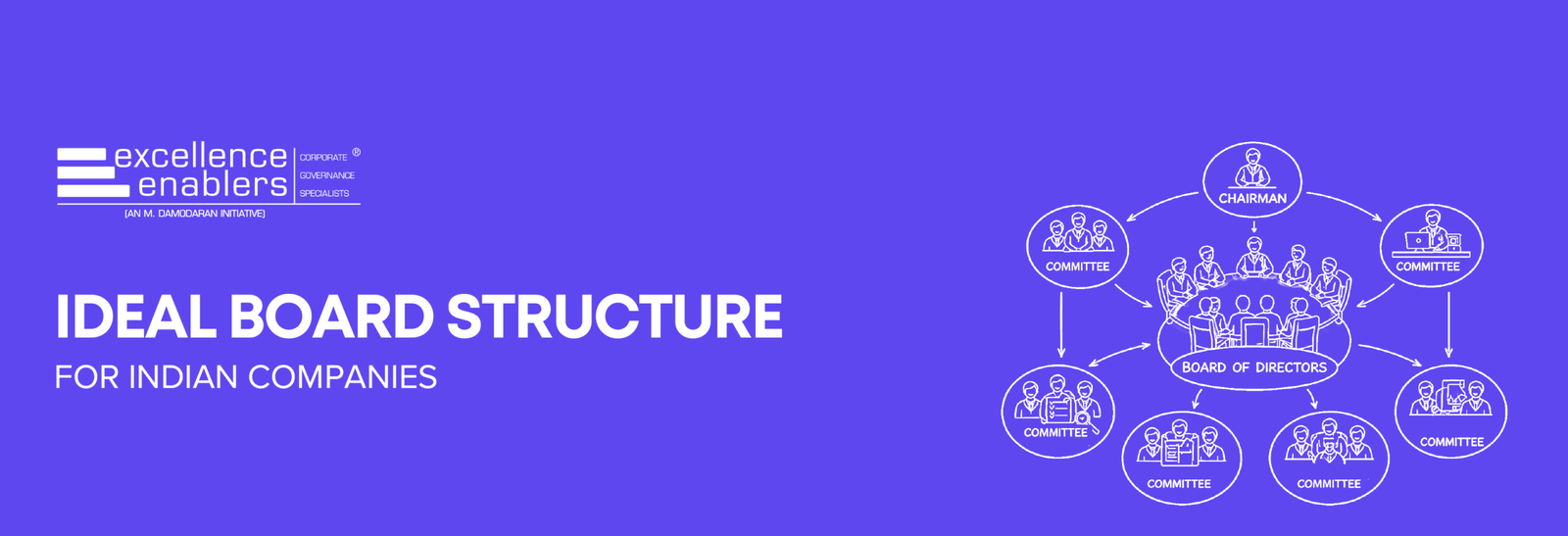
The structure of the Board is a critical determinant of a company’s long-term success. For effective governance, composition of the Board has to go beyond mere regulatory requirements. It should include factors such as its size, diversity, independence and experience. These factors directly influence the quality of decision-making, effectiveness of risk oversight, clarity in strategic directions, and creation of long-term stakeholder value. An ideal Board should not be too large, since it hampers meaningful discussions, or too small, since it prevents onboarding of diversity of experience. The size of the Board also should take into account the 5 mandatory committees that have to be constituted, and the need for an adequate number of Independent Directors (IDs).
An effective Board should have a balanced combination of Executive, Non-Executive Non-Independent and Independent Directors, where the Executive Directors (EDs) bring to the table sound operational insights and an understanding in company’s day-to-day functioning, whereas the Non-Executive Directors (NEDs) bring external perspectives and unbiased independent judgements. IDs play a very crucial role in bringing an outside perspective, aiding in balanced decision-making, eliminating management dominance, if any, and thereby safeguarding the interests of all stakeholders, including minority shareholders. Having too many EDs on the Board (as witnessed in PSUs, for example) may result in large unwieldy Boards, while too few EDs, or no EDs, may lead to imbalance, wherein operational expertise would not be available to the Board. Some Boards also have the practice of having no ED, which causes a problem in authorising Board documents. Hence optimal balance is a crucial need for ideal Board composition.
Diversity is one more key pillar of a well-constituted Board. Diversity must go beyond gender. Gone are the days when having one woman ID signified diversity. Evolved Boards focus on talent, and not tokenism, while inducting women on Boards. Diversity in the Board should also factor in age, expertise/professional background, and geographical representation. Diverse Boards enhance the understanding of the market and help to promote innovation. The Nomination and Remuneration Committee (NRC) plays an important role in identifying the skillsets required for the Board, and identifying right persons to be appointed as Directors, ensuring that the Board is equipped with the required proficiencies such as legal, finance, technology and domain experts. NRCs have a big role to play in determining the requirements for Boards of the future.
A clear distinction in the roles and responsibilities at the leadership level strengthens effective governance. The separation of roles and responsibility of Chairperson and Managing Director (MD) is widely viewed as best practice, as it prevents concentration of powers in the hands of one individual, and contributes to healthy checks. While the Chairperson is responsible to lead the Board, and ensuring effective governance, MD is accountable for the execution of strategies and management operations.
A balanced, independent and experienced Board, endorsed by role clarity enables companies to navigate the complexities and thereby drive the long-term success.
Komal Shah
© 2026 Excellence Enablers. All Rights Reserved.

